
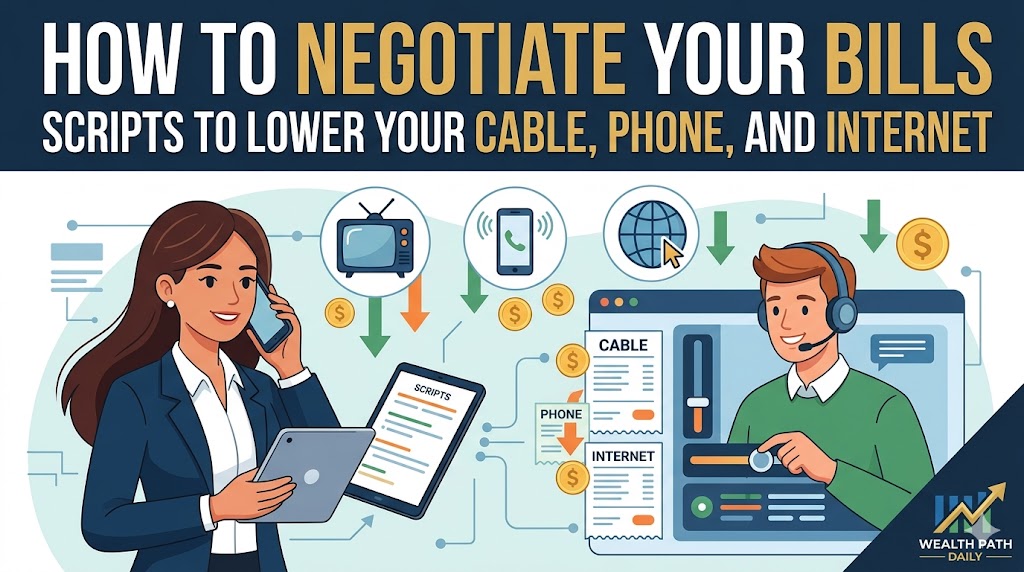
You work hard for your money, carefully budget for your groceries, and diligently set aside cash for savings. But what about the money leaving your account on autopilot every single month?
If you are like most people, you probably set up your internet, cable, and cell phone plans years ago and have simply accepted the slow, creeping price hikes ever since. Service providers rely on this exact behavior. They bank on the fact that you are too busy, too intimidated, or too complacent to call and challenge your current rate. In the personal finance world, this is known as the “loyalty penalty.”
Here at Wealth Path Daily, we want to put an end to the loyalty penalty. Negotiating your recurring bills is one of the highest-return activities you can do. A 15-minute phone call could easily save you $50 a month, which translates to $600 a year staying in your pocket.
If the thought of calling customer service makes you break out in a cold sweat, do not worry. This guide will walk you through exactly how to prepare, the psychology of the call, and the exact word-for-word scripts you need to successfully lower your bills today.
Phase 1: The Preparation (Before You Call)
Do not pick up the phone without doing your homework. Customer service representatives are trained to handle objections, so you need to be armed with data.
Know Your Current Usage
Are you paying for unlimited data but only using 5GB a month? Are you paying for 500 channels when you only watch live sports and local news? Review your last three statements to understand what you are actually using. You might be able to lower your bill simply by downgrading to a tier that better fits your lifestyle.
Research the Competition
This is your most powerful piece of leverage. Spend ten minutes researching what competitor companies are offering for new customers in your area. Write down the name of the competitor, the exact package, and the price.
Check Your Own Provider’s Promotions
Go to your current provider’s website and look at their deals for new customers. If you are paying $90 a month for internet and they are offering the exact same speed to new customers for $50, you have prime ammunition for your negotiation.
Phase 2: The Golden Rules of Negotiation
Before we get to the scripts, keep these actionable tips in mind when navigating the phone tree:
- Be undeniably polite, but firm: The representative on the other end is a human being doing their job. Being rude will get you nowhere. Treat them with respect, but do not back down from your goal.
- Ask for the Retention Department: The first tier of customer service usually does not have the authority to give you the best discounts. You want to speak to the “Customer Retention” or “Customer Loyalty” department. Their specific job is to prevent you from canceling.
- Leverage silence: After you make your request, stop talking. Let the representative fill the silence. Many people negotiate against themselves because they feel awkward during pauses.
- Be genuinely ready to walk away: Negotiations work best when your threat to leave is real. If another provider truly has a better deal, be mentally prepared to make the switch if your current company will not budge.
Phase 3: The Negotiation Scripts
When you get a representative on the line, take a deep breath and use one of these proven scripts.
Script 1: The “Competitive Match”
Use this script when you have researched a competitor’s offer.
You: “Hi there. I was reviewing my monthly budget and realized my current bill is a bit higher than I’d like to pay. I’ve been a loyal customer for [Number] years, but I saw that [Competitor Name] is offering a similar package for [Competitor Price]. I would love to stay with you, but the savings are hard to ignore. What can you do to match this price?”
Script 2: The “New Customer Promotion”
Use this script when you see your own provider offering a better deal to strangers than they are to you.
You: “Hello! I am calling because my bill has crept up recently. I noticed on your website that you are offering my exact plan to new customers for [Lower Price]. As someone who has reliably paid my bill on time for [Number] years, I’d like to have my rate adjusted to match this current promotional price.”
Script 3: The “Threat to Cancel” (The Nuclear Option)
If the representative claims there is nothing they can do, it is time to escalate.
You: “I understand you might be limited in what you can offer. However, [Current Price] just doesn’t fit my budget anymore. If we can’t find a way to lower this bill today, I am going to have to cancel my service and schedule an installation with [Competitor Name]. Can you please transfer me to the cancellation department?”
Note: Once transferred to the cancellation (retention) department, repeat Script 1 or 2. They have the best tools to keep you.
Phase 4: What to Do If They Say No
Sometimes, despite your best efforts, the representative genuinely cannot lower your rate. If you hit a brick wall, do not give up.
First, ask for one-time credits. You can say: “If you can’t lower the monthly rate, can you offer a statement credit or waive my equipment rental fee for the next six months?”
Second, remember the “HUCA” rule: Hang Up and Call Again. You might have simply reached an unhelpful representative or someone nearing the end of a long shift. Calling back the next day connects you with a different person who might be much more willing to work with you.
Finally, follow through. If they absolutely refuse to negotiate and a competitor offers a significantly better deal, make the switch. Loyalty to a corporation does not pay the bills.
Conclusion
Negotiating your bills is not about being cheap; it is about being financially efficient. Every dollar you trim from your fixed expenses is a dollar you can redirect toward paying off debt, investing in the stock market, or funding your next vacation.
Set aside one hour this week to audit your cable, phone, and internet bills. Do your research, use the scripts provided, and confidently ask for a better rate. You have absolutely nothing to lose and potentially hundreds of dollars to gain.
Stay tuned to Wealth Path Daily for more actionable personal finance strategies designed to help you build a richer, more intentional life.