
Have you ever reached the end of the month, checked your bank account balance, and felt a sudden wave of panic? You paid your rent, covered your utility bills, and bought groceries, but somehow, hundreds of dollars have vanished into a black hole of random Amazon purchases, quick coffee shop stops, and impromptu takeout orders.
If your budget feels like a leaky bucket, you are not alone. Lifestyle creep and the convenience of one-click spending make it incredibly easy to lose track of where our hard-earned money is going.
Here at Wealth Path Daily, we advocate for sustainable, long-term wealth-building strategies. But sometimes, to fix a leaky budget, you don’t need a gentle adjustment—you need a hard reset. Enter one of the most effective, eye-opening exercises in personal finance: The “No-Spend” Month Challenge.
If you are ready to break bad spending habits, drastically lower your expenses, and give your savings account a massive injection of cash, here is your complete survival guide to mastering a no-spend month.
What Exactly is a “No-Spend” Month?
Let’s clear up a common misconception right away: a no-spend month does not mean you spend absolutely zero dollars. You still have to pay your rent or mortgage, keep the lights on, and feed yourself.
A no-spend month is a committed period of 30 days where you freeze all discretionary spending. You only spend money on absolute necessities.
What is allowed:
- Rent/Mortgage
- Utility bills (water, electricity, internet)
- Basic groceries (ingredients, not pre-made luxury meals)
- Essential transportation (gas for commuting, basic transit passes)
- Minimum debt payments
- Essential medications
What is NOT allowed:
- Dining out, takeout, or food delivery
- Coffee shop trips
- Clothing and accessories
- Hobbies, craft supplies, or video games
- Entertainment (movie theaters, concert tickets)
- Impulse buys from targeted social media ads
The goal is not to punish yourself; the goal is to break the mindless cycle of consumerism and force yourself to become intensely aware of your financial triggers.
A Step-by-Step Guide to Surviving (and Thriving)
Successfully completing a no-spend month requires more than just willpower. It requires strategic preparation. Here is how to set yourself up for victory.
Step 1: Define Your “Why”
Willpower is a finite resource, and halfway through the month, you are going to desperately want to order a pizza. When that moment comes, you need a powerful reason to say no. Why are you doing this challenge? Are you trying to aggressively pay off a credit card balance? Are you saving for a down payment on a house? Are you trying to build a $1,000 emergency fund? Write your “why” on a sticky note and put it on your refrigerator and your bathroom mirror.
Step 2: Establish the Ground Rules Early
Before day one begins, sit down and write out your personal rulebook. What constitutes a “basic grocery” for your household? Are you allowing a small buffer for emergency car repairs? By defining the rules in black and white beforehand, you eliminate the gray areas that lead to cheating later in the month.
Step 3: Take a Pantry and Freezer Inventory
A no-spend month is the perfect time to eat down your pantry. Take an inventory of all the canned goods, frozen vegetables, and half-empty boxes of pasta you already own. Plan your meals for the first two weeks around these existing items. This drastically reduces your allowed grocery budget and ensures no food goes to waste.
Step 4: Unsubscribe and Unplug
Your inbox and social media feeds are designed to make you spend money. A week before your challenge begins, ruthlessly unsubscribe from retail email newsletters. Delete food delivery apps from your phone. Remove your saved credit card information from your web browser to create friction if you get tempted to shop online. Out of sight, out of mind.
Actionable Tips to Avoid Cracking Under Pressure
The first week is usually easy because you are running on adrenaline and motivation. Weeks two and three are where the real challenge begins. Use these actionable tips to stay on track:
- Embrace Free Entertainment: A no-spend month forces you to get creative. Swap movie theater dates for a hike in a local state park. Visit your local library to borrow books, movies, and even video games. Host a board game night at your house instead of meeting friends at a bar.
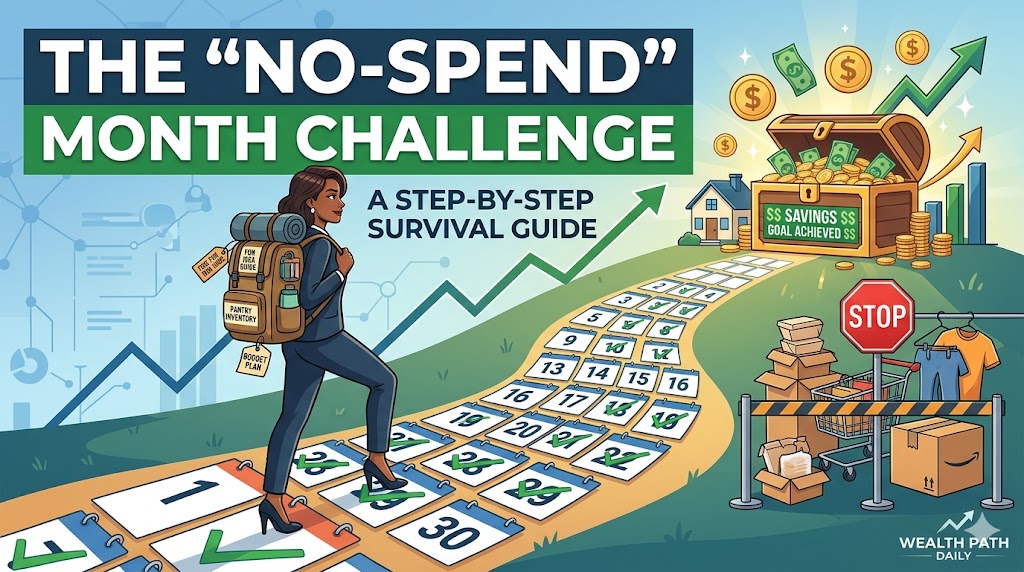
- Track Your Progress Visually: Print out a calendar for the month and hang it on your wall. For every day you successfully avoid discretionary spending, draw a big green “X” over the date. Jerry Seinfeld famously used this “don’t break the chain” method for writing jokes, and it works flawlessly for habit building.
- Communicate with Your Circle: Tell your friends, family, and coworkers that you are doing a no-spend month. You don’t have to over-explain your financial situation; simply say, “I’m doing a personal finance challenge this month, so I’m strictly cooking at home.” True friends will support you and happily agree to free hangouts.
- Implement the 48-Hour Rule for the Future: When you feel the urge to buy something you can’t have, write it down on a “Wants” list. Tell yourself you can evaluate buying it after the month is over. Usually, by the time the 30 days are up, the urge to buy the item has completely vanished.
What to Do With the Money You Save
The most critical step of a no-spend month happens on the very last day. You will likely find that you have a surplus of cash sitting in your checking account—money that usually would have bled out through a hundred tiny purchases.
Do not leave it there! If it stays in your checking account, you will simply spend it next month.
Immediately move those funds to a designated location that serves your “Why.” Transfer it to your high-yield savings account to bolster your emergency fund, or make a massive lump-sum payment toward your highest-interest debt.
Conclusion
The “No-Spend” Month Challenge is not meant to be a permanent lifestyle. Living indefinitely without ever treating yourself is a surefire recipe for burnout. Think of this exercise as a financial detox. It clears out the bad habits, resets your baseline for what you actually “need,” and proves to you just how much financial traction you can gain in a short amount of time.
Prepare your rules, clear out your pantry, delete those delivery apps, and give it a try. You might be shocked to discover that the best things in your life truly don’t cost a dime.
Stay tuned to Wealth Path Daily for more actionable personal finance strategies designed to help you build a richer, more intentional life.