
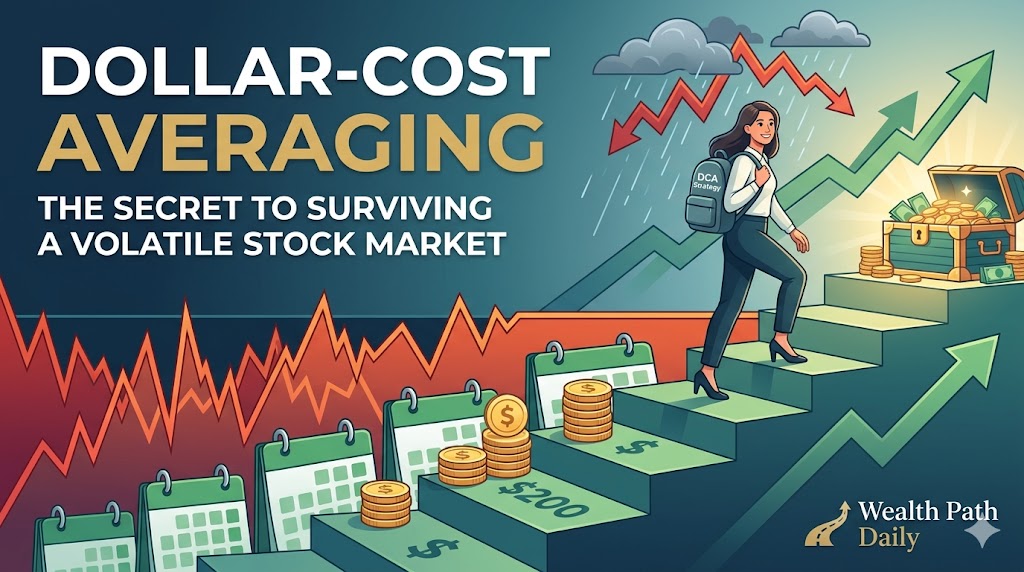
Turn on the financial news on any given day, and you are likely to be bombarded with dramatic headlines. “Market Plunges Amid Interest Rate Fears!” or “Tech Stocks Erase Trillions in Value!” For a beginner investor, watching the stock market swing wildly from day to day can be a stomach-churning experience.
It is entirely natural to look at your hard-earned money dipping in value and feel a sudden, overwhelming urge to sell everything and hide your cash under a mattress. Alternatively, you might be sitting on the sidelines with cash in hand, paralyzed by the fear of investing right before a crash.
Here at Wealth Path Daily, we understand that market volatility is the number one reason people are afraid to invest. But what if there was a simple, mathematically proven strategy that could completely remove the stress of a turbulent market? What if market crashes could actually work in your favor?
Enter the ultimate superpower for everyday investors: Dollar-Cost Averaging (DCA). If you want to build long-term wealth without constantly obsessing over daily stock charts, this is the only survival guide you will ever need.
What is Dollar-Cost Averaging?
Despite the intimidating name, Dollar-Cost Averaging is an incredibly simple concept.
Dollar-Cost Averaging is the practice of investing a fixed, set amount of money into the exact same investment at regular intervals, regardless of what the stock market is doing.
It does not matter if the market is at a record-breaking all-time high or if it is crashing in the middle of a global recession. If your strategy is to invest $200 on the 1st and 15th of every month, you invest that $200 without hesitation.
You completely ignore the noise, the news, and the current price. You just stick to the schedule.
The Math Behind the Magic: How DCA Lowers Your Risk
To understand why this strategy is so effective, we have to look at the math. When you invest a fixed dollar amount, the natural fluctuation of stock prices automatically works to your advantage.
Think about it like buying your favorite brand of coffee. If you always spend exactly $20 on coffee every month, you will buy fewer bags when the price goes up to $10 a bag (you get 2 bags). But when the coffee goes on sale for $5 a bag, that same $20 automatically buys you more (you get 4 bags).
The exact same principle applies to the stock market.
Let’s say you commit to investing $500 a month into a broad-market index fund:
- Month 1: The market is booming. The index fund costs $100 per share. Your $500 buys you 5 shares.
- Month 2: The market crashes! The price drops to $50 per share. You might feel panicked, but your scheduled $500 investment now buys you 10 shares.
- Month 3: The market recovers slightly to $75 per share. Your $500 buys you 6.6 shares.
Instead of trying to guess when the market was at its lowest, your fixed $500 naturally bought fewer shares when they were expensive, and more shares when they were “on sale.” Over time, this smooths out your purchase price, lowering the average cost per share and insulating you from sudden market drops.
The Psychology of DCA: Removing Emotion from Investing
While the math of Dollar-Cost Averaging is excellent, the psychological benefits are even better.
Humans are biologically wired to be terrible investors. We are driven by two overpowering emotions: Fear and Greed. When the market is soaring (greed), we want to throw all our money in at the absolute peak. When the market is crashing (fear), we panic and sell our investments at a massive loss.
The alternative to DCA is trying to “time the market”—waiting with a lump sum of cash to buy at the exact bottom. However, study after study shows that even Wall Street professionals cannot accurately or consistently predict the market’s bottom.
Dollar-Cost Averaging removes human emotion from the equation. It takes the guesswork out of investing. You never have to ask yourself, “Is today a good day to buy?” because the answer is always predetermined by your schedule.
Actionable Steps: How to Set Up Your DCA Strategy Today
Implementing a Dollar-Cost Averaging strategy is one of the easiest financial moves you can make. It requires a brief setup, and then it runs on autopilot. Here is your step-by-step guide to executing DCA:
- Evaluate Your Budget: Look at your monthly cash flow and determine a realistic amount you can afford to invest without sacrificing your living expenses or emergency fund. Even if it is just $50 a week, consistency is more important than the initial dollar amount.
- Choose Your Investment Vehicle: DCA works best with diversified, long-term investments rather than volatile individual stocks. Broad-market index funds or ETFs (like an S&P 500 or Total Stock Market fund) are ideal for this strategy.
- Determine Your Frequency: Decide how often you want to invest. Many people choose to align this with their paychecks (e.g., bi-weekly or monthly).
- Automate the Process: This is the most crucial step. Do not rely on your own memory or willpower to manually transfer the funds. Log into your brokerage account and set up recurring, automatic transfers and investments. Make it invisible.
- Hold the Line During a Crash: When the inevitable market correction happens, do not turn off your automatic investments. Remind yourself that a market crash simply means you are acquiring more shares at a steep discount.
Conclusion
Market volatility is not a bug in the financial system; it is a feature. It is the necessary price of admission for the high long-term returns the stock market provides.
As a beginner investor, you cannot control inflation, interest rates, or global economic news. However, you can control your own behavior. By embracing Dollar-Cost Averaging, you transform market volatility from a terrifying threat into a systematic wealth-building tool.
Set your budget, automate your investments, and let the math work its magic.
Stay tuned to Wealth Path Daily for more actionable personal finance strategies designed to help you build a richer, more intentional life.