
There is an undeniable thrill that comes with buying an individual stock. When you purchase shares in a specific company, you are no longer just a consumer; you are a part-owner. If the company succeeds, you share in the profits. It is the cornerstone of capitalist wealth building.
However, for every spectacular success story in the stock market, there are countless cautionary tales of investors who lost their shirts. It is incredibly easy to get swept up in a compelling narrative, a charismatic CEO, or a trendy new product.
Here at Wealth Path Daily, we consistently advocate that the foundation of your portfolio should be built on low-cost, broad-market index funds. But if you have your financial house in order and want to allocate a small percentage of your portfolio to picking individual stocks, you need a robust defense mechanism. You need to know how to spot a sinking ship before you buy a ticket.
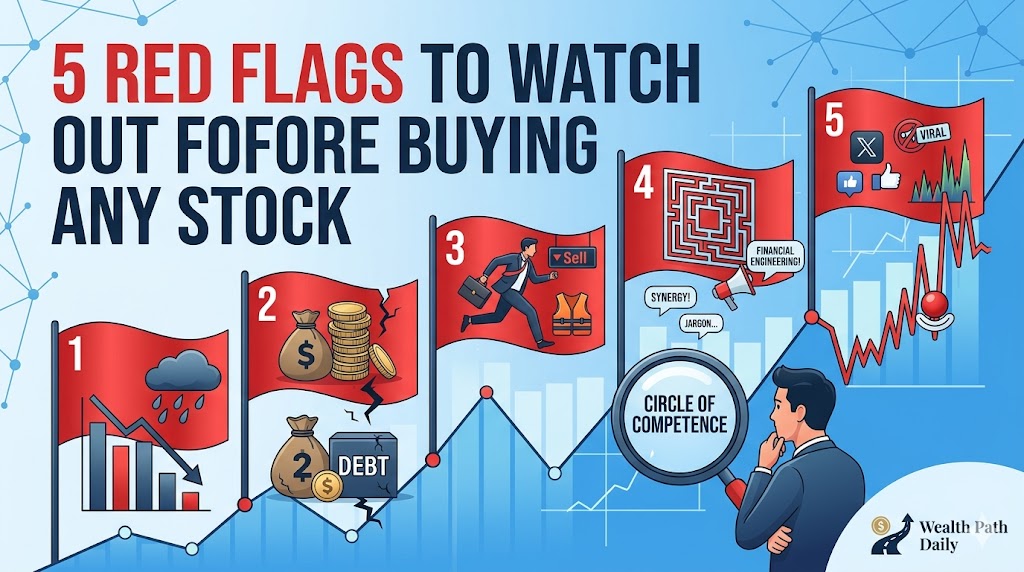
Before you hit the “Buy” button on your brokerage app, put the company through this rigorous screening process. Here are 5 glaring red flags to watch out for before buying any stock.
1. Declining Revenue and Shrinking Profit Margins
When analyzing a company, you always want to start by looking at the top and bottom lines of their income statement.
Revenue (The Top Line): This is the total amount of money the company brings in from sales. If a company’s revenue is consistently shrinking year after year, it is a massive red flag. It means they are losing market share, their products are becoming obsolete, or they are failing to attract new customers.
Profit Margins (The Bottom Line): A company can bring in billions of dollars in revenue, but if their costs are too high, they won’t make a dime in actual profit. Watch the company’s profit margins closely. If revenue is going up but profit margins are shrinking, it indicates that the company is spending unsustainably to acquire those sales, or that inflation and supply chain issues are eating them alive. A healthy company should demonstrate both growing revenue and stable or expanding profit margins.
2. A Mountain of Unsustainable Debt
Debt is not inherently evil. Many successful companies use debt strategically to build new factories, fund research and development, or expand into new markets. However, in personal finance and corporate finance alike, too much debt is a death sentence—especially in an environment with rising interest rates.
When a company carries massive amounts of high-interest debt, a huge portion of their cash flow goes strictly toward servicing that debt rather than reinvesting in the business or rewarding shareholders.
To spot this red flag, look at the company’s Debt-to-Equity Ratio (easily found on any major financial website). If this ratio is significantly higher than its industry competitors, or if the company has highly leveraged its balance sheet just to stay afloat, walk away. You do not want to be a shareholder when the bill comes due.
3. High Executive Turnover or Massive Insider Selling
The people running the company know more about its true health than any Wall Street analyst ever will. Therefore, you should always pay attention to what the leadership team is doing.
If a company experiences a sudden wave of executive departures—especially the sudden resignation of the Chief Financial Officer (CFO) or the Chief Executive Officer (CEO)—it is often a sign of internal turmoil or impending bad news.
Similarly, pay attention to “insider trading.” (Not the illegal kind, but the legal buying and selling of stock by executives, which must be publicly reported to the SEC). It is perfectly normal for executives to sell small portions of their stock to buy a house or pay for their children’s college. But if the CEO and the board of directors are suddenly dumping massive blocks of their own shares, take the hint. If the captain is quietly putting on a life jacket, you shouldn’t be boarding the ship.
4. A Confusing or Overly Complex Business Model
Legendary investor Warren Buffett famously advises people to stay within their “Circle of Competence.” If you cannot explain how a company makes money in one or two simple sentences to a ten-year-old, you have no business investing your hard-earned money in it.
During the dot-com bubble and recent cryptocurrency booms, investors poured billions of dollars into companies whose business models were built on confusing jargon, complex financial engineering, and vague promises of future synergy.
Never invest in a company just because it sounds smart. Read their annual report (the 10-K). Do they sell a physical product? Do they charge a software subscription fee? How exactly does cash flow from the customer’s wallet into the company’s bank account? If the answer is buried under layers of corporate buzzwords, consider it a giant red flag.
5. Heavy Reliance on Hype Rather Than Substance
In the age of social media, “meme stocks” have become a dangerous phenomenon. These are companies whose stock prices skyrocket not because the business is doing well, but simply because the stock has gone viral on platforms like Reddit, TikTok, or X.
Investing based on hype, fear of missing out (FOMO), or social media momentum is not investing; it is gambling.
When a stock’s price completely detaches from its underlying fundamentals (earnings, cash flow, assets), a crash is mathematically inevitable. By the time you hear about a “hot stock tip” from a neighbor or a trending hashtag, the easy money has already been made by the early speculators, and the trap is set for the retail investor. Always base your investments on cold, hard data, never on hype.
Your Pre-Purchase Actionable Checklist
To protect your portfolio, run every individual stock pick through this quick actionable checklist before you buy:
- Read the latest Earnings Report: Are sales and profits growing or shrinking?
- Check the P/E (Price-to-Earnings) Ratio: Is the stock wildly overvalued compared to its historical average or its competitors?
- Review Insider Activity: Are executives actively buying shares (a great sign) or aggressively dumping them (a red flag)?
- Understand the Moat: Does this company have a unique competitive advantage (a strong brand, patents, high switching costs) that protects it from rivals?
- Write down your “Why”: Write a one-paragraph thesis on exactly why you are buying the stock and what specific metric would cause you to sell it. If you can’t articulate it on paper, don’t buy it.
Conclusion
Picking individual stocks can be a rewarding way to participate in the growth of innovative companies, but it requires diligent research and a critical eye. Remember that Wall Street is designed to sell you an optimistic story. Your job as a savvy investor is to look past the marketing, dig into the numbers, and aggressively hunt for reasons not to buy.
By avoiding companies with shrinking revenues, toxic debt, sketchy leadership, confusing business models, and unjustified hype, you will naturally steer clear of the market’s biggest landmines. Protect your capital first, and the wealth will follow.
Stay tuned to Wealth Path Daily for more actionable personal finance strategies designed to help you build a richer, more intentional life.