
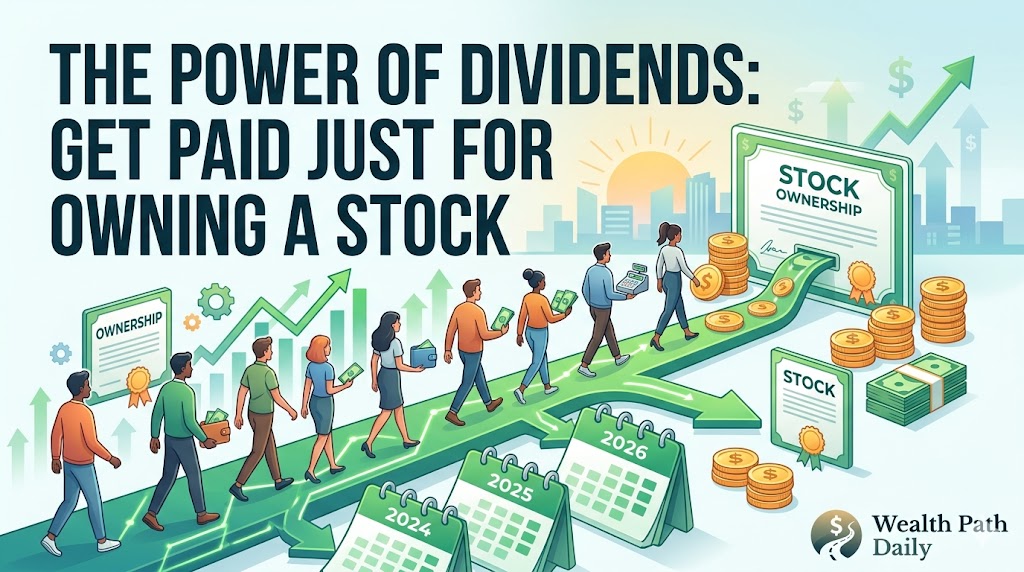
When most people think about investing in the stock market, they picture the classic Wall Street mantra: Buy low, sell high. They imagine buying a stock for $50, anxiously watching the ticker symbol for years, and hoping to eventually sell it for $100 to capture the profit.
While capital appreciation (the price of the stock going up) is a fantastic way to build wealth, it comes with one major flaw: you only actually make money when you sell the asset. And once you sell it, that asset can never make you money again.
But what if there was a way to generate a reliable, predictable stream of income from your investments without ever having to sell a single share?
Here at Wealth Path Daily, we believe that true financial independence is achieved when your assets pay for your lifestyle. Today, we are going to dive into one of the most powerful, time-tested strategies for generating truly passive income: Dividend Investing.
If you want to understand how to get paid just for being an owner, here is your complete beginner’s guide to the power of dividends.
What Exactly is a Dividend?
To understand dividends, you have to remember what a stock actually is. When you buy a share of stock, you are not just trading a digital ticker symbol; you are buying partial ownership in a real, living, breathing business.
When a mature, profitable company makes money, the board of directors has a choice to make regarding what to do with all that extra cash. They can reinvest it back into the business (build new factories, hire more staff, buy out a competitor), or they can distribute a portion of those profits directly back to the owners—the shareholders.
That cash distribution is called a dividend.
Most dividend-paying companies in the United States distribute these payments on a quarterly basis (four times a year). If a company pays an annual dividend of $4.00 per share, you will automatically receive a $1.00 cash deposit into your brokerage account every three months for every single share you own. You don’t have to do anything. You literally get paid for simply holding the stock.
Understanding “Dividend Yield”
When researching stocks, you will frequently see the term “Dividend Yield.” This is simply the financial ratio that shows how much a company pays out in dividends each year relative to its stock price.
The Math: If a stock is trading at $100 per share, and the company pays an annual dividend of $4.00 per share, the dividend yield is 4%. This metric helps you easily compare the income potential of different stocks, regardless of their individual share prices.
Why Dividend Investing is a Financial Superpower
Focusing on dividends completely shifts your mindset from being a stock speculator to being a business owner. Here is why this strategy is a cornerstone of so many wealthy investors’ portfolios.
1. The Ultimate Passive Income
Real estate is a great way to generate cash flow, but it requires dealing with tenants, toilets, and property taxes. Side hustles require your time and energy. Dividends, on the other hand, require absolutely zero ongoing effort. The cash simply appears in your account, year after year, as long as the company remains profitable.
2. A Buffer Against Market Volatility
The stock market will inevitably experience downturns. Watching your portfolio drop in value is stressful. However, high-quality dividend-paying companies usually continue to pay their dividends even during recessions. This steady stream of cash flow softens the psychological blow of a bear market and provides you with tangible returns even when stock prices are falling.
3. A Hedge Against Inflation
Cash sitting in a savings account slowly loses its purchasing power due to inflation. But great businesses have pricing power; they can raise the prices of their products when inflation hits. Consequently, the best dividend-paying companies consistently raise their dividend payouts every single year, ensuring your passive income grows faster than the cost of living.
The Secret Weapon: Dividend Reinvestment Plans (DRIP)
If you take your dividend cash and spend it on coffee, you are missing out on the true magic of this strategy. To build massive wealth, you must utilize a DRIP (Dividend Reinvestment Plan).
When you turn on DRIP in your brokerage account, you are instructing your broker to automatically take your cash dividends and use them to buy more shares of that exact same stock.
This creates a snowball effect:
- Your shares pay you a dividend.
- That dividend automatically buys more shares.
- Because you now own more shares, your next dividend payment is bigger.
- That bigger dividend buys even more shares.
Over a 20-to-30-year investing timeline, the compounding power of reinvested dividends is responsible for a massive portion of the stock market’s total historical return.
4 Golden Rules for Building a Dividend Portfolio
If you are ready to start building your own dividend snowballs, follow these actionable tips to avoid common beginner mistakes:
- 1. Beware the “Yield Trap”: A ridiculously high dividend yield (like 10% or 12%) is usually a massive red flag. Remember the math: yield is driven by the stock price. Often, a yield is only that high because the underlying stock price has completely collapsed. The company is likely in financial trouble and will soon cut or eliminate the dividend entirely.
- 2. Focus on the “Dividend Aristocrats”: Don’t just look for who is paying the most today; look for who pays most reliably. The “Dividend Aristocrats” are an elite group of S&P 500 companies that have successfully increased their dividend payout every single year for at least 25 consecutive years. These are massive, stable, blue-chip companies with proven track records.
- 3. Check the Payout Ratio: This tells you how much of the company’s total profit is being paid out as dividends. If a company earns $1.00 per share in profit and pays out $0.50 in dividends, the payout ratio is a healthy 50%. If they earn $1.00 but pay out $1.20, they are going into debt to pay you, which is highly unsustainable. Look for payout ratios below 60%.
- 4. Diversify with Dividend ETFs: You don’t have to pick individual stocks to be a dividend investor. You can buy Dividend-focused Exchange Traded Funds (ETFs), which instantly give you exposure to hundreds of high-quality, dividend-paying companies in a single, low-cost investment.
Your Actionable Getting-Started Checklist
Ready to earn your first dividend? Tackle this simple checklist this week:
- Log into your brokerage account.
- Navigate to your account settings and locate the “Dividend Reinvestment Plan” (DRIP) option.
- Toggle DRIP to “On” for your entire portfolio.
- Research low-cost Dividend ETFs or look up the current list of Dividend Aristocrats.
- Commit to a monthly budget to consistently buy shares, regardless of whether the market is up or down.
Conclusion
The power of dividends lies in their simplicity and inevitability. Every time you buy a dividend-paying asset, you are buying a tiny, automated cash-printing machine. While a $2.00 dividend payment might not seem like much today, the magical combination of time, consistent contributions, and DRIP can transform those small quarterly payments into a torrent of cash flow capable of entirely replacing your day job.
Stop focusing solely on the fluctuating price of a stock, and start focusing on the cash flow it can produce.
Stay tuned to Wealth Path Daily for more actionable personal finance strategies designed to help you build a richer, more intentional life.