
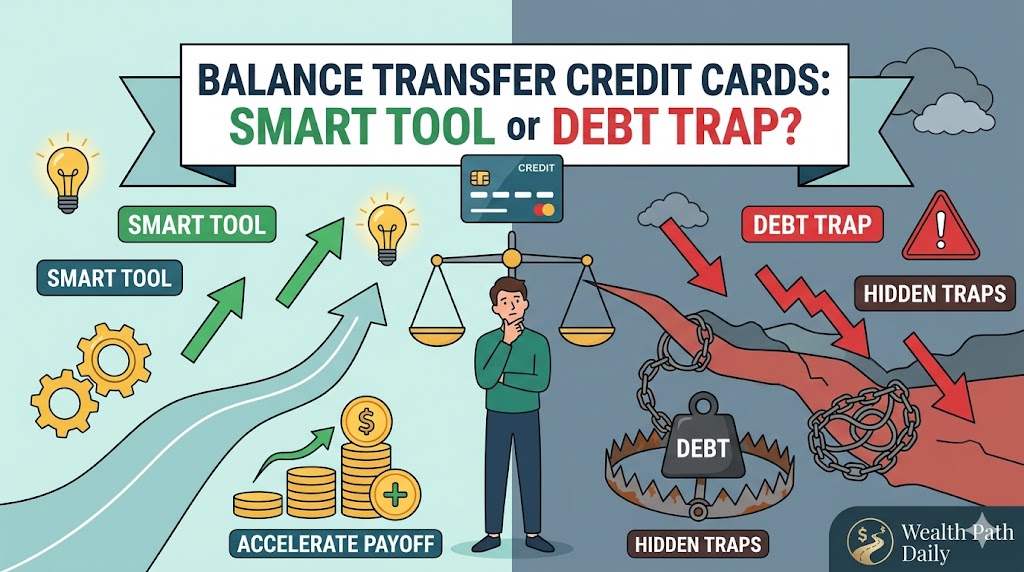
If you are currently carrying a balance on a standard credit card, you are likely intimately familiar with a very specific type of financial frustration. You diligently make your monthly payment, but when the next statement arrives, the balance has barely budged.
With average credit card interest rates hovering well above 20%, high-interest debt can feel like trying to run a marathon while wearing a weighted vest. The math is simply working against you.
When you are suffocating under the weight of compounding interest, the sudden appearance of a pre-approved offer for a “0% APR Balance Transfer Credit Card” in your mailbox can feel like a miraculous lifeline. But before you eagerly sign on the dotted line, you have to ask yourself a critical question: Are the credit card companies actually trying to help you, or are they luring you into a trap?
Here at Wealth Path Daily, we want to help you navigate the tricky waters of debt payoff. A balance transfer card can absolutely be a brilliant, money-saving tool—but only if you use it correctly. Here is the ultimate guide to understanding how balance transfers work, when they are a smart move, and how to avoid the hidden traps.
What Exactly is a Balance Transfer?
At its core, a balance transfer is essentially refinancing your credit card debt.
You apply for a new credit card that offers a promotional 0% Annual Percentage Rate (APR) for a set period—usually ranging from 12 to 21 months. Once approved, the new credit card company pays off the balance on your old, high-interest card, and moves that debt over to the new card.
For the duration of the promotional period, your debt does not accrue a single penny of interest. Every dollar you pay goes directly toward wiping out the principal balance.
The Pros: Why It Can Be a Smart Financial Tool
When used strategically, a balance transfer is one of the most effective ways to accelerate your debt payoff journey.
1. Massive Interest Savings
This is the primary draw. If you have a $5,000 balance at 24% APR and you pay $250 a month, it will take you 27 months to pay it off, and you will bleed out over $1,400 in interest charges. If you move that same $5,000 to a 0% APR card and pay $250 a month, you will be entirely debt-free in 20 months, and you will pay exactly $0 in interest.
2. Debt Consolidation and Simplicity
If you are juggling multiple credit cards with different due dates, minimum payments, and interest rates, it is incredibly easy to miss a payment. A balance transfer allows you to combine multiple balances into one single, manageable monthly payment.
3. A Psychological Boost
Debt fatigue is real. Seeing 100% of your payment actually reduce the total amount you owe provides a massive psychological boost. It gives you the visible momentum you need to stay aggressively committed to becoming debt-free.
The Cons: How It Becomes a Dangerous Debt Trap
Credit card companies are incredibly profitable businesses, and they are not offering 0% APR out of the goodness of their hearts. They offer these promotions because statistically, they know a large percentage of people will fail to pay off the balance in time. Here is how the tool becomes a trap.
1. The Hidden Balance Transfer Fee
Moving your money is rarely free. Almost all balance transfer cards charge an upfront fee, typically between 3% and 5% of the total amount transferred. If you transfer $10,000 with a 5% fee, $500 is immediately added to your new balance. You have to do the math to ensure the interest you save outweighs this upfront fee.
2. The Promotional Cliff
That beautiful 0% APR does not last forever. It has a strict expiration date. If you have not paid off the entire balance by the time the 12, 15, or 21-month period ends, the remaining balance will be hit with the card’s standard, exorbitant interest rate (often 20% to 29%).
3. The Illusion of New Credit
This is the biggest behavioral trap. Once you transfer the balance off your old credit card, that old card now has a zero balance and a fully available credit limit. For someone who has not fixed their core spending habits, the temptation to start using that old card again is overwhelming. Suddenly, you have a maxed-out balance transfer card and a newly maxed-out standard credit card. You have essentially doubled your debt.
How to Use a Balance Transfer Card Successfully
If you decide to utilize a balance transfer, you must treat it with military precision. Do not leave your payoff to chance. Follow this strict, actionable checklist to guarantee success:
- Calculate the Monthly Target: Take your total transferred balance (including the 3-5% transfer fee) and divide it by the number of months in your promotional period. If you transfer $5,000 (plus a $150 fee) for 15 months, your target monthly payment is $343.33.
- Set Up Autopay Immediately: Do not rely on your memory. Log into your new account on day one and set up an automatic monthly transfer for your exact target amount.
- Never Use the New Card for Purchases: A balance transfer card has one job: holding your old debt while you kill it. Do not use this card to buy groceries, gas, or a new TV. New purchases can complicate how your payments are applied and ruin your payoff timeline.
- Freeze the Old Cards: Literally or metaphorically, put your old credit cards on ice. Delete them from your Apple Pay, remove them from your favorite online retailers, and put the physical cards in a drawer. Do not close the accounts (as that can hurt your credit score), but make them incredibly difficult to use.
- Read the Fine Print: One late payment on your new card is often enough to void the 0% promotional offer entirely, instantly triggering the penalty APR. Pay on time, every time.
Conclusion
A balance transfer credit card is like a power tool. In the hands of someone with a clear plan and disciplined spending habits, it can help you construct a debt-free life months or even years faster than you would otherwise. However, if used carelessly, it can cause immense financial damage.
Before applying for a balance transfer, take a hard, honest look at your financial habits. If you have addressed the root cause of your overspending and are ready to ruthlessly execute a payoff plan, a 0% APR card might be the exact tool you need to finally break the chains of high-interest debt.
Stay tuned to Wealth Path Daily for more actionable personal finance strategies designed to help you build a richer, more intentional life.