
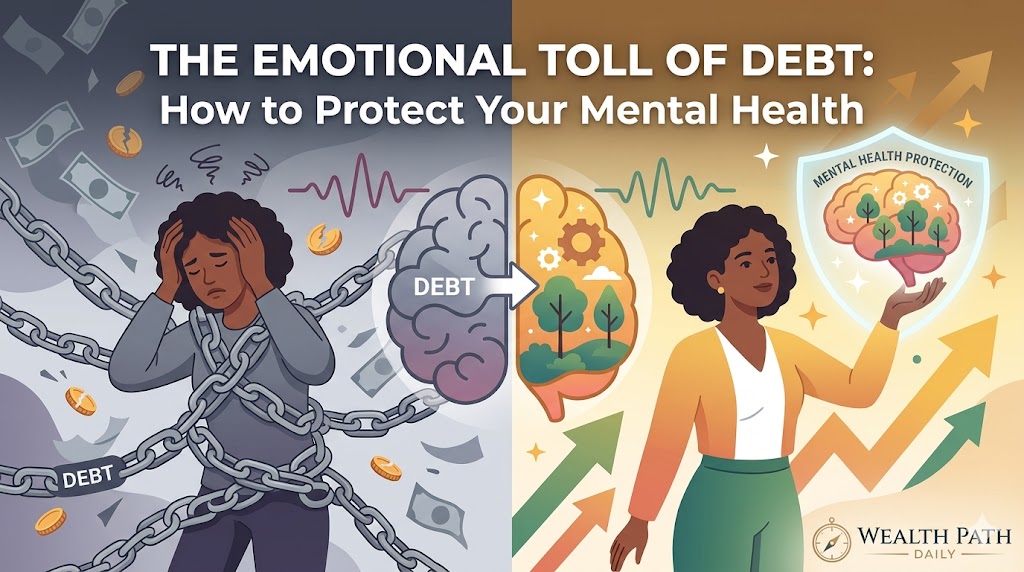
When we talk about personal finance, the conversation usually revolves around cold, hard numbers. We discuss interest rates, credit utilization ratios, and the mathematical beauty of compound interest. But if you are currently carrying a heavy load of debt, you already know the truth: debt is rarely just a math problem.
Debt is a deeply emotional experience. It is the pit in your stomach when the phone rings with an unknown number. It is the silent, pervasive anxiety that keeps you staring at the ceiling at 2 A.M. It is the guilt you feel when you buy a simple cup of coffee, and the shame that prevents you from discussing your struggles with friends or family.
Here at Wealth Path Daily, we focus heavily on the strategies and mechanics of building wealth. But we also recognize that you cannot fix your finances if you are mentally and emotionally running on empty. Acknowledging the psychological weight of your financial situation is the first, and most crucial, step toward overcoming it.
If your debt is currently dictating your mood, your relationships, and your peace of mind, here is your guide to understanding the emotional toll of debt and, more importantly, how to protect your mental health while you pay it off.
The Hidden Cost of Borrowing: Why Debt Hurts So Much
Before you can address the emotional impact of debt, you have to understand why it affects us so profoundly. In modern society, money is inexorably tied to survival, security, and status. When that security is threatened, our brains react exactly as they would to a physical threat.
The Cycle of Shame and Isolation
Debt thrives in darkness. Because there is a widespread cultural stigma surrounding financial struggles, most people choose to suffer in silence. You might decline dinner invitations with friends, claiming you are “just too busy,” when the reality is you are terrified of looking at your bank balance. This isolation breeds a toxic cycle of shame. You convince yourself that you are the only one struggling, which makes the burden feel twice as heavy.
Decision Fatigue and Chronic Anxiety
When finances are tight, every single purchase becomes a high-stakes decision. Can I afford this gas? If I pay the electric bill today, will my rent check bounce tomorrow? This constant state of hyper-vigilance leads to severe decision fatigue. Your brain is expending so much energy trying to survive the day-to-day math that you have no mental bandwidth left for your career, your relationships, or your personal well-being.
The Physical Connection: How Stress Manifests
It is also vital to recognize that the emotional toll of debt often manifests physically. Chronic financial stress keeps your body flooded with cortisol, the primary stress hormone.
Over time, this heightened state of alert can lead to very real physical symptoms, including:
- Chronic insomnia and disrupted sleep patterns
- Tension headaches and migraines
- Digestive issues and changes in appetite
- A weakened immune system, making you more susceptible to illness
You are not imagining the physical exhaustion. Your body is physically reacting to the psychological burden of owing money.
5 Actionable Strategies to Protect Your Mental Health
You cannot snap your fingers and make your debt disappear, but you absolutely can change how you interact with it emotionally. Here is an actionable checklist to help you reclaim your mental health while you navigate your debt payoff journey.
1. Separate Your Self-Worth from Your Net Worth
This is the most critical mindset shift you can make. Your credit score is just a three-digit algorithm used by banks to assess lending risk. It is not a grade on your character, your intelligence, or your worth as a human being. Acknowledge that you made financial mistakes—or were simply dealt a bad hand by life—but refuse to let those circumstances define your identity. You are a person experiencing debt; you are not your debt.
2. Break the Silence and Find Your Community
Shame loses its power the moment it is spoken aloud. You do not have to broadcast your financial situation to the world, but you must find at least one safe person to talk to. This could be a trusted friend, a partner, or even an anonymous online community of people on the exact same debt-free journey. Realizing that millions of other smart, capable people are fighting the exact same battle will instantly lift a massive weight off your shoulders.
3. Create a “Brain Dump” Budget
Anxiety thrives on uncertainty. When you don’t know exactly how much you owe, your brain imagines the absolute worst-case scenario. The cure for this specific anxiety is radical clarity. Sit down with a piece of paper and write down every single debt, interest rate, and minimum payment. Then, create a strict written budget for the month. By taking the numbers out of your head and putting them on paper, you transition from a state of panic to a state of planning.
4. Automate to Reduce Anxiety
If logging into your accounts to make payments triggers a panic attack, remove yourself from the equation. Set up your minimum payments on automatic draft right after your payday. Automation removes the monthly emotional hurdle of manually handing over your money, reducing your decision fatigue and ensuring you never miss a due date.
5. Celebrate the “Micro-Wins”
Paying off a mountain of debt is a marathon that can take years. If you only allow yourself to feel good when the balance hits zero, you will burn out. Protect your motivation by celebrating the micro-wins. Did you stick to your grocery budget this week? Celebrate it. Did you pay off your smallest credit card? Celebrate it. Find free or incredibly cheap ways to reward your discipline and acknowledge your progress.
Conclusion
The journey out of debt is just as much a mental battle as it is a mathematical one. You cannot hate yourself into financial prosperity, and punishing your mental health will not make the balances drop any faster.
Give yourself the grace to acknowledge that this is difficult. By breaking the silence, getting organized, and intentionally protecting your emotional well-being, you take away the power the debt has over you. You regain control of the steering wheel. The debt will eventually disappear, but your mental health is your most valuable lifelong asset—protect it fiercely.
Stay tuned to Wealth Path Daily for more actionable personal finance strategies designed to help you build a richer, more intentional life.