
Quitting your 9-to-5 job to become a full-time freelancer is one of the most exhilarating decisions you can make. You suddenly have the freedom to choose your clients, set your own schedule, and work from anywhere with a Wi-Fi connection. You are finally the CEO of your own life.
But usually, around month three, a terrifying reality sets in: the predictable, bi-weekly paycheck is gone.
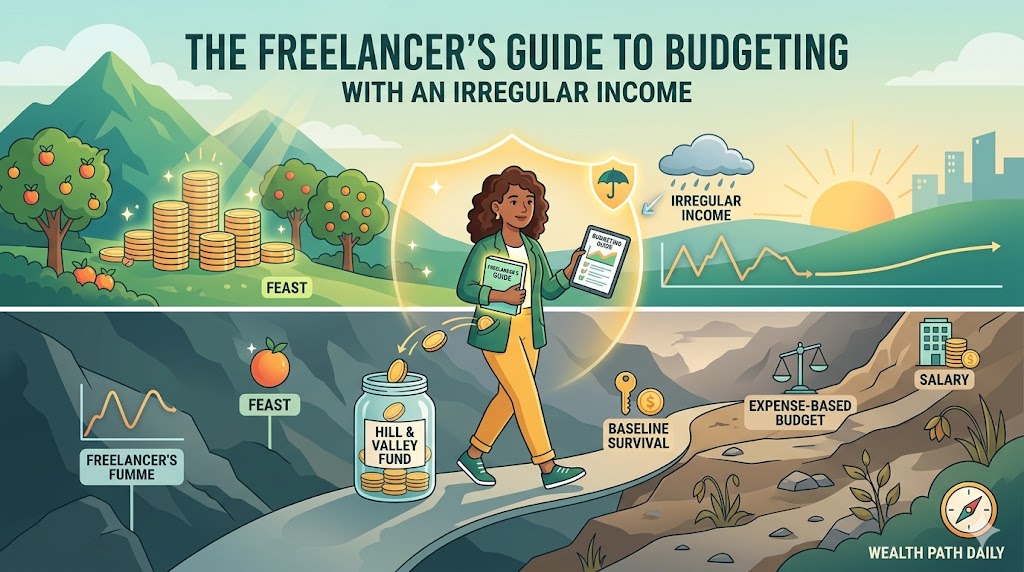
Welcome to the freelancer’s “feast or famine” cycle. One month, you close three massive projects and feel like you are printing money. The next month, two clients delay their invoices, no new leads come in, and you are left staring at your bank account, wondering how you are going to pay rent.
Traditional budgeting advice—like the popular 50/30/20 rule—assumes you know exactly how much money is hitting your checking account on the first of the month. When your income fluctuates wildly, those standard rules fly right out the window.
Here at Wealth Path Daily, we believe that you should not have to sacrifice financial peace of mind to enjoy the freedom of self-employment. If you are tired of riding the cash-flow roller coaster, here is your definitive, step-by-step guide to budgeting with a wildly unpredictable income.
Why Standard Budgets Fail Freelancers
When a salaried employee creates a budget, they start at the top with their income and allocate it downward until they hit zero.
When you have an irregular income, you have to flip that model completely upside down. You cannot budget based on what you hope to make; you must budget based on what you need to survive. This requires a shift from “Income-Based Budgeting” to “Expense-Based Budgeting.”
Here is how to build a financial system that can withstand the driest of dry spells.
Step 1: Calculate Your “Baseline Survival Number”
Before you can manage variable income, you need absolute clarity on your fixed expenses. Your Baseline Survival Number (BSN) is the absolute bare minimum amount of money you need to keep the lights on and stay alive for one month.
This is not a “fun” budget. It does not include dining out, new clothes, or vacations. It should only include:
- Housing (Rent or Mortgage)
- Basic Utilities (Water, electricity, internet)
- Groceries (Basic sustenance, not premium dining)
- Minimum Debt Payments
- Essential Insurance (Health, auto)
- Critical Business Overhead (Software subscriptions necessary to do your job)
Let’s say you calculate this and your BSN is $3,000. That number is now your monthly financial anchor. Everything you do revolves around hitting that $3,000 target.
Step 2: Build the “Hill and Valley” Fund
Everyone needs an emergency fund for unexpected events like a blown tire or a medical bill. But freelancers need a second, entirely separate reserve called a Hill and Valley Fund (sometimes called an income stabilization fund).
In freelancing, there will be “hills” (months where you make $8,000) and “valleys” (months where you make $1,000). Your Hill and Valley fund acts as a shock absorber.
Your goal is to save up at least two to three months’ worth of your Baseline Survival Number (e.g., $6,000 to $9,000) in a separate, high-yield savings account. When you have a valley month and only earn $1,000, you don’t panic; you simply transfer $2,000 from your Hill and Valley fund to your checking account to cover your BSN.
Step 3: The “Prioritized Allocation” Method
So, how do you handle your money when a massive $10,000 client check finally clears? When you have irregular income, you cannot spend money just because it is sitting in your account. You must distribute every dollar based on a strict hierarchy of needs.
Whenever a payment hits your account, allocate the funds in this exact numbered order:
- The Tax Man First (25% – 30%): Unlike a W-2 job, no one is withholding your taxes for you. The second a check clears, immediately transfer 25% to 30% into a separate “Tax Savings” account. Do not look at it, and do not touch it until quarterly estimated taxes are due.
- Cover the Current Month’s Baseline: Next, fill up your checking account until you hit your Baseline Survival Number for the current month.
- Refill the Valley Fund: If you had to dip into your Hill and Valley fund during a slow period, use the remaining money to top it back up to its target amount.
- Buffer the Next Month: If your current month and your Valley fund are fully funded, take the excess cash and apply it to next month’s Baseline Survival Number.
- Wealth Building and Lifestyle: Only after you have covered taxes, the current month, your safety net, and a month ahead should you use the remaining funds for investing (like funding an IRA), paying down debt aggressively, or treating yourself to a nice dinner.
Step 4: Pay Yourself a Consistent “Salary”
One of the most powerful psychological tricks for freelancers is to mimic a traditional paycheck.
You must open a dedicated Business Checking Account. All client payments, PayPal transfers, and Stripe payouts should go into this business account. Then, on the 1st and 15th of every month, set up an automatic transfer from your Business Checking to your Personal Checking for a set, conservative amount (like half of your BSN).
By creating a wall between your business revenue and your personal checking account, you force yourself to live on a steady, predictable “salary,” completely insulating your daily emotions from the volatility of your business cash flow.
Actionable Tips to Smooth Your Cash Flow
While mastering your budget is critical, you should also actively work to make your income less erratic. Implement these strategies this week:
- Require Upfront Deposits: Never begin work without a financial commitment. Require 30% to 50% upfront before you type a single word or write a single line of code. This provides immediate cash flow and filters out bad clients.
- Pitch Retainer Agreements: Look at your best, most consistent clients. Offer them a slight discount in exchange for a 6-month retainer agreement where they pay a flat, recurring fee every month for a set amount of work.
- Diversify Your Client Base: If one client makes up 60% of your income, you are not a freelancer; you are a highly vulnerable employee without benefits. Actively prospect so that no single client accounts for more than 20% of your revenue.
Conclusion
Budgeting with an irregular income can feel incredibly daunting at first. It requires discipline, foresight, and a willingness to delay gratification when a big check arrives.
However, by establishing your baseline survival number, building an income stabilization fund, and paying yourself a consistent salary out of your business account, you can entirely eliminate the anxiety of the feast and famine cycle. You chose the freelance path to design a life of freedom. By taking control of your unpredictable cash flow today, you ensure that your finances serve that freedom, rather than sabotage it.
Stay tuned to Wealth Path Daily for more actionable personal finance strategies designed to help you build a richer, more intentional life.