
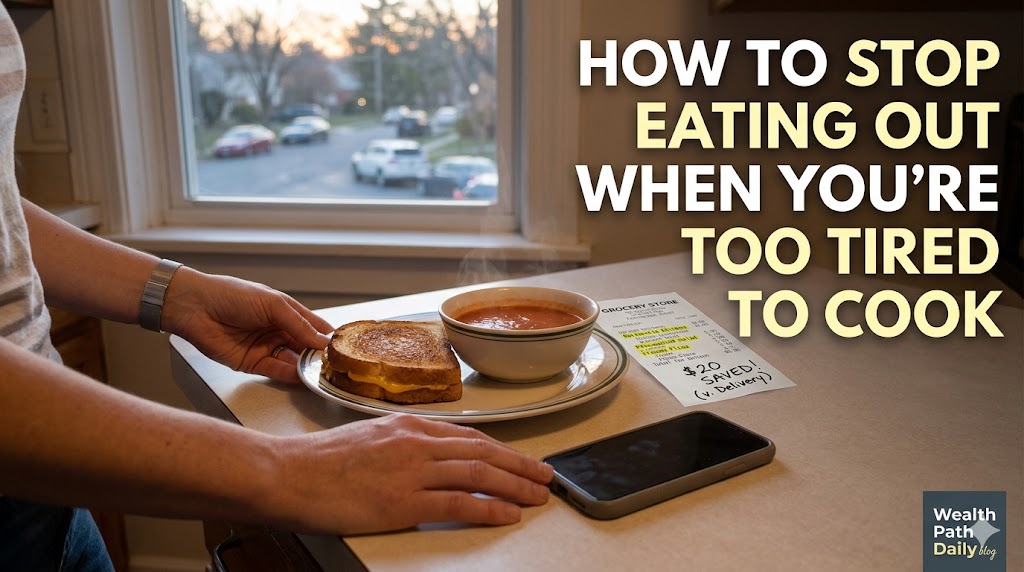
It is 6:00 PM on a Wednesday. You have had a long, exhausting day at work, the commute was terrible, and your brain feels completely fried. You open the fridge, stare blankly at a head of lettuce and some raw chicken, and close it. Before you even realize what you are doing, you are opening a food delivery app on your phone.
We all know this scenario intimately. It is the moment when our long-term financial goals clash violently with our immediate physical exhaustion. Here at Wealth Path Daily, we call this the “Exhaustion Tax”—the premium you pay for convenience when you simply do not have the energy to stand over a stove.
It is easy to justify a $25 takeout order in the moment by telling yourself you deserve a break. But the reality is that relying on restaurant food and delivery apps is one of the fastest ways to sabotage a carefully planned budget.
If you want to take control of your finances, you have to stop paying the Exhaustion Tax. Let us break down exactly how to stop eating out when you are too tired to cook, without relying on sheer willpower.
The Hidden Cost of the Exhaustion Tax
First, we have to look at the math to understand what is truly at stake.
Let us assume you give in to the Exhaustion Tax just three times a week, spending an average of $25 per meal (which is conservative if you are using delivery apps with service fees and tips). That is $75 a week, or $300 a month. Over the course of a year, you are spending $3,600 on convenience dining.
That is $3,600 that could have funded a Roth IRA, aggressively paid down a high-interest credit card balance, or fully funded a frugal dream vacation. The problem is not that you lack financial discipline; the problem is that you are relying on willpower when your mental energy is at its absolute lowest point.
To win this battle, you do not need to try harder. You need a better system.
Build a System That Requires Zero Willpower
Decision fatigue is a well-documented psychological phenomenon where the quality of your decisions deteriorates after a long day of making choices. By the time dinner rolls around, your brain is simply done making decisions.
To stop eating out, you have to remove the decision-making process from your evenings entirely. Here are five foolproof strategies to keep you out of the drive-thru.
1. Create an “Emergency” Freezer Stash
Your freezer is your greatest financial ally. The next time you have the energy to make a large batch of chili, soup, or a casserole on a weekend, intentionally double the recipe. Portion the second half into individual, freezer-safe containers. When that Wednesday evening exhaustion hits, you do not have to cook; you just have to use the microwave. It takes significantly less time to heat up homemade chili than it does to wait for a delivery driver.
2. Keep “Assemblage Meals” on Hand
Not every dinner has to be a from-scratch culinary masterpiece. Give yourself permission to have meals that require assembly rather than actual cooking. A grocery store rotisserie chicken, a bag of pre-washed salad greens, and some microwaveable rice can be turned into a healthy, filling dinner in exactly three minutes. Stocking up on these “convenience groceries” is slightly more expensive than buying raw ingredients, but it is infinitely cheaper than restaurant delivery.
3. Master the 15-Minute Meal
Restaurant delivery usually takes at least 30 to 45 minutes from the moment you place the order. Learn three to four ultra-fast recipes that take 15 minutes or less from start to finish. Think scrambled eggs and toast, a grilled cheese sandwich with canned tomato soup, or quick-boil pasta with jarred marinara sauce. When you remind yourself that cooking is actually faster than waiting for takeout, the urge to open the delivery app diminishes.
4. Embrace the “Fake Takeout” Strategy
Sometimes you aren’t just tired; you specifically crave comfort food. Anticipate this human reality. Keep a high-quality frozen pizza, a bag of frozen potstickers, or frozen chicken strips in your house at all times. When you are desperately craving pizza delivery, throw your $6 frozen pizza in the oven. You satisfy the craving, save $20, and keep your budget intact.
5. Use the “Pay Yourself the Tip” Trick
If you are teetering on the edge of ordering food, put your desired meal into a delivery app and look at the final total cost, including the service fees, delivery fees, and driver tip. Often, a $15 meal inflates to $28 at checkout. If you choose to close the app and heat up soup instead, immediately transfer that $28 from your checking account into your savings account. Watching your savings balance grow in real-time is an incredible motivator to keep cooking.
Actionable Tips for Meal Planning Success
Implementing a solid weeknight dinner system requires a little bit of strategic prep work. Use these actionable tips to set yourself up for consistent success:
- The 5-Ingredient Rule: Keep your weeknight dinner recipes to five ingredients or fewer. Less chopping means less physical effort and significantly fewer dishes to wash afterward.
- Prep Immediately After Shopping: Do not put whole, unwashed vegetables in the crisper drawer. Wash and chop your onions, peppers, and carrots the moment you get home from the grocery store. When Tuesday night arrives, half the work is already done.
- Implement Theme Nights: Eliminate daily decision fatigue by assigning themes to days. Taco Tuesday, Pasta Wednesday, Leftover Thursday. You never have to ask, “What is for dinner?” again.
- Never Cook Hungry: Eat a small snack (like an apple or a handful of almonds) on your commute home or right before you start dinner. Attempting to cook while you are starving is a guaranteed trigger for giving up and ordering takeout.
- Lower Your Standards: A peanut butter and jelly sandwich is a perfectly acceptable dinner. Breakfast for dinner is a perfectly acceptable dinner. Release the pressure of making a picture-perfect, balanced meal every single night.
Conclusion: Reclaim Your Money and Your Evenings
Breaking the cycle of convenience dining is one of the most effective, immediate ways to accelerate your journey to financial independence. It is entirely normal to feel too tired to cook—the modern workweek is demanding, and decision fatigue is real.
However, by acknowledging that exhaustion and preparing for it with emergency freezer meals, quick assembly options, and a forgiving mindset, you can protect your wealth path. Stop paying the Exhaustion Tax. Give those dollars a better job, embrace the beauty of a simple 15-minute meal, and watch how quickly your budget transforms when your kitchen becomes your favorite (and cheapest) restaurant.