
Have you ever checked your bank account balance and felt a sudden, sinking pit in your stomach? You earn a decent income, you pay your bills on time, yet somehow, by the end of the month, your money has vanished into a black hole of takeout, targeted Instagram ads, and impulse Amazon purchases.
This is the financial equivalent of a junk-food bender, and it leaves you with a massive “spending hangover.” When spending becomes a mindless coping mechanism rather than a conscious choice, traditional budgeting often isn’t enough to stop the bleeding. You don’t need a minor adjustment; you need a circuit breaker.
Here at Wealth Path Daily, we believe the fastest way to regain control of your money is to step away from the noise entirely. Enter the 30-Day Financial Detox.
Also known as a “no-spend month,” a financial detox is a temporary, aggressive strategy designed to break your bad consumer habits, hit the reset button on your dopamine receptors, and put a fast infusion of cash back into your bank account. Here is your ultimate guide to surviving—and thriving—during your 30-day reset.
What is a Financial Detox?
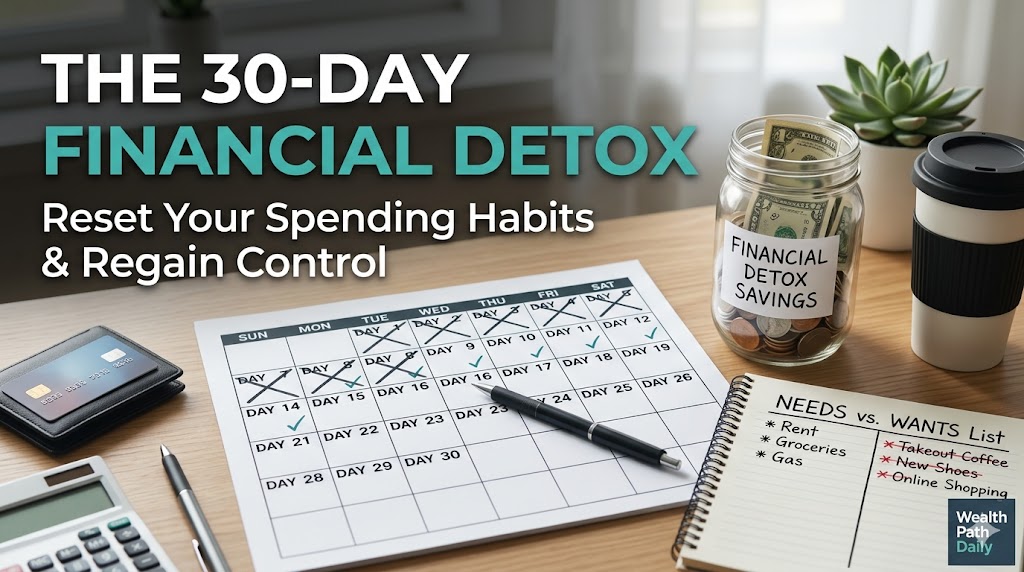
A financial detox is a strict 30-day period where you commit to spending money only on absolute necessities. You freeze all discretionary spending.
To be clear, this is not a permanent lifestyle. Just like a juice cleanse or a dietary detox, you are not meant to live in this state of extreme restriction forever. The goal is temporary disruption. By forcing yourself to stop tapping your debit card for 30 consecutive days, you break the psychological loop of emotional spending. You are forced to confront your financial leaks, re-evaluate what actually brings you joy, and remember what it feels like to have money left over at the end of the month.
The Rules of the Detox
For a detox to work, the boundaries must be crystal clear before you begin. Ambiguity is the enemy of discipline.
What You CAN Spend On (The Essentials)
During these 30 days, your money only goes toward keeping you alive, housed, and employed. You are allowed to pay for:
- The Four Walls: Rent or mortgage, basic utilities (water, electricity, gas), and necessary insurance.
- Basic Groceries: Ingredients to cook meals at home. (Note: “Basic” means generic pantry staples, produce, and proteins—not $15 artisanal cheeses or premium frozen dinners).
- Transportation: Gas for your car to get to work, or a monthly public transit pass.
- Financial Obligations: Minimum debt payments and child support.
- Medications: Essential healthcare items.
What You CANNOT Spend On (The Extras)
If it is not required for your immediate survival, it is cut for the next 30 days. This includes:
- Dining Out: No restaurants, no delivery apps, no drive-thrus, and no coffee shops.
- Entertainment: No movie tickets, concert passes, or paid excursions.
- Shopping: No new clothes, shoes, home decor, or electronics.
- Hobbies: No buying new books, craft supplies, or video games.
- Convenience: No paying for premium parking, car washes, or impulse candy at the gas station.
6 Actionable Tips to Survive Your Detox
Going cold turkey on consumerism is a shock to the system. The first week will feel incredibly uncomfortable, but if you prepare your environment, you will set yourself up for success.
- Unsubscribe and Unfollow: Your inbox and social media feeds are carefully engineered to make you part with your money. For the next 30 days, unsubscribe from every single retail email newsletter. Mute or unfollow influencers whose primary content involves “hauls” or pushing products. Protect your peace and remove the temptation.
- Delete Saved Credit Cards: Go into your web browser, Amazon account, and Apple Pay/Google Wallet settings and delete your saved credit card numbers. If you want to buy something, you should be forced to physically get up, find your wallet, and type the numbers in. That tiny bit of friction is often enough to stop an impulse buy in its tracks.
- Embrace the “Pantry Challenge”: Use this month to eat through the food you already own. Dig into the back of your freezer, use up those half-empty boxes of pasta, and get creative with your spices. You will drastically lower your grocery bill while preventing food waste.
- Curate a List of Free Joy: You cannot just remove activities; you must replace them. Sit down and write out 10 things you enjoy doing that cost zero dollars. This could include hiking a local trail, visiting the public library, hosting a board game night with friends, or finally binge-watching that show on a streaming service you have already paid for.
- Implement the 30-Day Rule for Wants: When you inevitably see something you desperately want to buy, don’t tell yourself “no.” Tell yourself “not right now.” Write the item down in a notebook along with the date and the price. If you still want the item when your 30-day detox is over, you can budget for it then. (Spoiler alert: 90% of the time, you will completely forget about it).
- Track the Savings Visually: Keep a running tally of every dollar you would have spent. Every time you skip a $5 coffee or pass on a $40 takeout order, write that number on a whiteboard on your fridge. Watching the “saved” number grow gives you the dopamine hit you used to get from shopping.
The Aftermath: What to Do on Day 31
The true test of a financial detox does not happen during the 30 days; it happens on Day 31. The biggest mistake people make is treating the end of the detox like a finish line, immediately rushing to the mall or a fancy restaurant to “celebrate” with a massive spending binge.
When your detox ends, ease back into normal life slowly. Look at the money you saved over the last month and give every single dollar a job. Route that cash directly into your emergency fund, use it to make a massive dent in your credit card debt, or put it toward your Wealth Path investing goals.
Conclusion: Take Back Your Financial Power
A 30-Day Financial Detox is not about punishing yourself. It is about proving to yourself that you are the master of your money, not the other way around.
By stepping off the consumer treadmill for just one month, you will break the spell of impulse shopping, discover free ways to enjoy your life, and build incredible financial momentum. It will be challenging, it will be eye-opening, and it will be one of the most profitable months of your life. Are you ready to hit the reset button?