Getting denied for a car loan, rejected for an apartment application, or handed a credit card with an astronomical interest rate can feel like a punch to the gut. In today’s financial world, a low credit score can feel like a dark cloud following you everywhere, limiting your options and draining your bank account through exorbitant fees.
Whether your credit took a hit due to past mistakes, unexpected medical bills, or simply a lack of financial education, it is easy to feel hopeless. But here is the most important thing you need to hear today: Your credit score is not a permanent reflection of your character; it is simply a mathematical algorithm. And like any algorithm, once you understand the rules, you can make it work in your favor.
Here at Wealth Path Daily, we believe in actionable, no-nonsense financial strategies. While you cannot erase legitimate negative marks overnight, you can dramatically improve your score and prove your creditworthiness in a surprisingly short amount of time.
If you are tired of living with the stress of bad credit, here is your definitive, step-by-step guide to rebuilding your credit score from scratch in just six months.
Step 1: Face the Music and Pull Your Reports
You cannot fix a problem if you don’t know exactly what is broken. Your first step is to get a clear picture of where you stand.
By law, you are entitled to a free copy of your credit report from each of the three major credit bureaus (Equifax, Experian, and TransUnion) every year. Go to AnnualCreditReport.com (the only federally authorized site) and download all three.
Dispute the Errors
Once you have your reports, grab a highlighter and review them line by line. You are looking for mistakes: accounts that aren’t yours, late payments you actually paid on time, or debts that are older than seven years (which should have fallen off). If you find an error, dispute it directly with the credit bureau online. By law, they have 30 days to investigate, and if the creditor cannot verify the debt, it must be removed. This alone can cause an instant, massive jump in your score.
Step 2: Leverage the Power of a Secured Credit Card
If your credit is heavily damaged, traditional credit card companies will likely reject your applications. Every rejection results in a “hard inquiry,” which temporarily lowers your score even further. Stop applying for standard cards immediately.
Instead, you need a Secured Credit Card.
A secured card works exactly like a regular credit card, but it requires a refundable cash deposit upfront. If you put down a $200 deposit, your credit limit is $200. Because the bank has your cash as collateral, there is zero risk for them, meaning almost anyone can get approved regardless of their credit history.
How to Use It Correctly:
The goal of this card is not to buy things you cannot afford. The goal is simply to generate positive data for the credit bureaus.
- Use the card for one small, recurring subscription every month (like Netflix or Spotify).
- Put the card in a drawer and do not use it for anything else.
- Set up autopay to pay the balance in full, three days before the due date.
Step 3: Keep Your Credit Utilization Razor-Thin
To beat the credit algorithm, you have to understand how it calculates your score. The second largest factor in your FICO score (making up 30%) is your Credit Utilization Ratio. This is the amount of credit you are using compared to your total available credit limit.
If you have a $1,000 credit limit and you spend $900, your utilization is 90%. To the algorithm, you look desperate for cash, and your score will plummet.
To rebuild your score at lightning speed, you need to keep your utilization under 10%. Better yet, keep it between 1% and 5%. If your secured card has a $200 limit, never let the statement balance exceed $20. By paying the card off multiple times a month before the statement closes, you can artificially keep your reported utilization near zero, which the algorithm loves.
Step 4: Become an “Authorized User” (The Piggyback Method)
If you have a trusted family member or spouse with an impeccable credit history, you can ask them to add you as an “Authorized User” on one of their oldest, most pristine credit cards.
When they add you to their account, the entire history of that specific credit card—every on-time payment and the length of the account—is suddenly copied and pasted onto your credit report.
The Golden Rules of Piggybacking:
- The primary account holder does not have to actually give you the physical card (in fact, it is safer if they don’t, to protect their own finances).
- Ensure the card has a perfect payment history and a very low utilization rate.
- Verify that the credit card issuer actually reports authorized user activity to the three major bureaus.
Step 5: Report Your Alternative Data
Historically, the only way to build credit was by taking on debt. Today, the system is finally evolving.
There are now free, secure services (such as Experian Boost) that allow you to connect your checking account to your credit profile. These services scan your bank statements for consistent, on-time payments of utility bills, cell phone bills, and even streaming services. By adding these previously ignored payments to your credit file, you can often see an immediate, positive bump in your score within a matter of minutes.
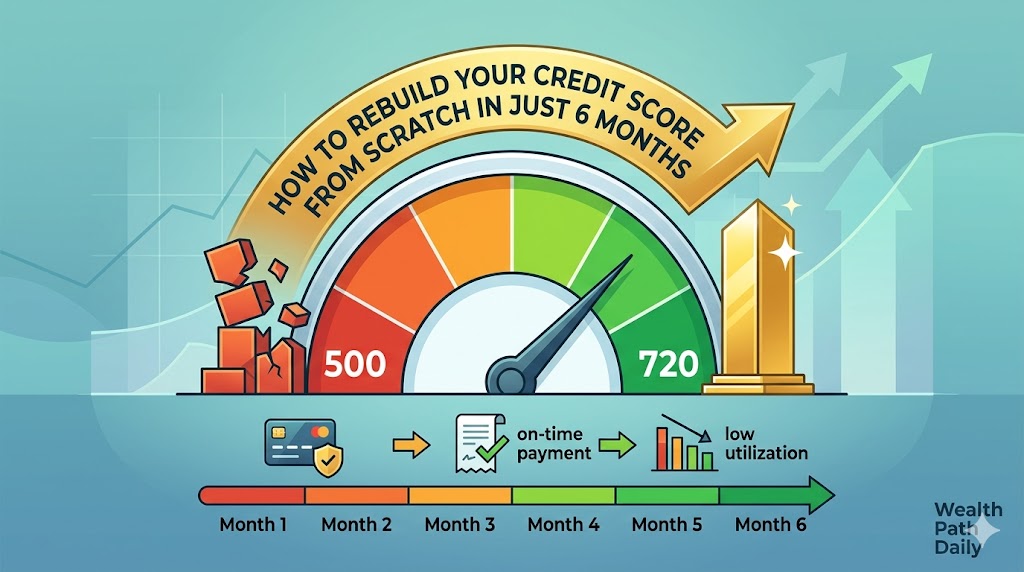
Your 6-Month Actionable Rebuilding Checklist
Rebuilding credit is a marathon, but the first six months are where you establish the pace. Print out this checklist and tape it to your fridge:
- Month 1: Pull your three free credit reports, dispute any inaccurate information, and open one secured credit card.
- Month 2: Set up your secured card for one small automated purchase (e.g., a $15 streaming service) and set up automated payments to pay it off entirely.
- Month 3: Have a conversation with a trusted family member about becoming an authorized user on an old, high-limit card.
- Month 4: Sign up for an alternative data reporting tool to get credit for your utility and phone bills.
- Month 5: Audit your progress. Check your free VantageScore through your bank or a free monitoring app to ensure your positive payments are being actively reported.
- Month 6: Maintain militant consistency. By this point, your on-time payment streak and low utilization will begin to heavily outweigh your past negative marks.
Conclusion
Rebuilding your credit score from scratch is entirely within your control. It does not require paying hundreds of dollars to shady “credit repair” companies, nor does it require going into massive debt.
It simply requires understanding the rules of the algorithm and executing a disciplined, boring, and consistent strategy. By disputing errors, leveraging secured cards, keeping your utilization aggressively low, and automating your success, you can transform your financial reputation in just six months.
Take a deep breath, pull those reports, and start your rebuilding journey today. Your future self will thank you.
Stay tuned to Wealth Path Daily for more actionable personal finance strategies designed to help you build a richer, more intentional life.