Graduation day is supposed to be one of the best days of your life. You walk across the stage, grab your diploma, and look forward to a bright, lucrative future. But for millions of graduates, that excitement is quickly overshadowed by a massive, looming storm cloud: the student loan balance.
Whether you owe $10,000 or $100,000, navigating the repayment process can feel like trying to solve a puzzle with missing pieces. In recent years, the conversation around student debt has become incredibly noisy. Between shifting political promises, complex federal programs, and the sheer mathematical weight of compounding interest, you are likely facing a massive financial crossroads.
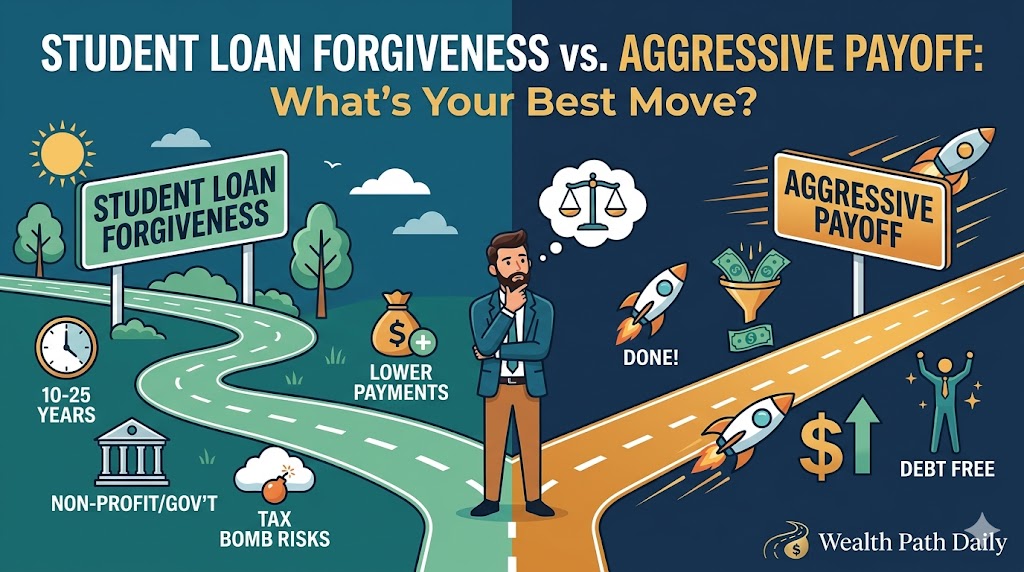
Should you cross your fingers, enroll in a government program, and wait for Student Loan Forgiveness? Or should you roll up your sleeves, live on rice and beans, and execute an Aggressive Payoff strategy?
Here at Wealth Path Daily, we know that there is no universal “right” answer. Your student loan strategy depends entirely on your career path, your income, and your psychological tolerance for debt. Let’s cut through the noise, examine the pros and cons of both paths, and help you determine your best move.
The Case for Student Loan Forgiveness
When we talk about student loan forgiveness, we are generally not talking about a magical, one-time sweeping cancellation of all debt. We are usually talking about specific, structured federal programs designed to forgive your remaining balance after you meet strict requirements over a long period.
Public Service Loan Forgiveness (PSLF)
If you work for a government agency or a qualifying 501(c)(3) non-profit organization, PSLF is the holy grail of forgiveness programs.
How it works: You must make 120 qualifying monthly payments (which takes 10 years) under an Income-Driven Repayment (IDR) plan while working full-time for a qualifying employer. After 120 payments, the entire remaining balance is completely forgiven, and the forgiven amount is not taxed as income.
Income-Driven Repayment (IDR) Forgiveness
If you work in the private sector and don’t qualify for PSLF, you can still seek forgiveness through standard IDR plans.
How it works: You enroll in a repayment plan that caps your monthly payment at a percentage of your discretionary income (usually 10% to 20%). If you make these payments for 20 or 25 years (depending on the specific plan), the remaining balance is forgiven.
The Pros and Cons of Waiting for Forgiveness
- The Pros: Your monthly payments stay low, allowing you to direct your cash toward other wealth-building goals, like investing in index funds or saving for a down payment on a house. If you owe a massive amount (like from medical or law school) but earn a modest public-sector salary, PSLF can save you hundreds of thousands of dollars.
- The Cons: You are tying yourself to a massive bureaucracy. You must recertify your income every year, and any paperwork error can derail your timeline. Furthermore, under standard IDR forgiveness (non-PSLF), the amount forgiven at the end of 20 or 25 years is currently treated by the IRS as taxable income. This is known as the “Tax Bomb,” and it can leave you owing the IRS tens of thousands of dollars in a single year.
The Case for Aggressive Payoff
On the other side of the spectrum is the aggressive payoff strategy. This involves ignoring the possibility of forgiveness, living well below your means, and throwing every spare dollar at your debt until the balance hits zero.
The Guaranteed Return on Investment
When you pay off a student loan with a 6% interest rate, you are effectively guaranteeing yourself a 6% return on your money. In a volatile stock market, finding a guaranteed, risk-free 6% return is impossible. By paying the debt off early, you are saving yourself thousands of dollars in interest over the life of the loan.
The Psychological Freedom
Debt is not just a math problem; it is a psychological burden. Carrying debt limits your options. It might keep you stuck in a toxic job because you need the steady paycheck, or prevent you from taking an entrepreneurial risk. The mental clarity and freedom that come from owing nothing to anyone cannot be overstated.
The Pros and Cons of Aggressive Payoff
- The Pros: You are entirely in control of your own destiny. You don’t have to worry about shifting government policies, filing complex paperwork, or surviving the IDR “Tax Bomb.” Once it is gone, it is gone forever.
- The Cons: It requires massive short-term sacrifice. Every extra dollar you send to your student loan servicer is a dollar you cannot invest in the stock market, use for a vacation, or put toward a home.
How to Decide: Your Actionable Checklist
Still torn? Use this actionable checklist to determine which path makes the most mathematical and emotional sense for your specific situation:
- Calculate Your Debt-to-Income (DTI) Ratio: If your student loan balance is significantly lower than your annual salary (e.g., you owe $30,000 but make $70,000), aggressive payoff is almost always the best route. You can crush that debt quickly. If your balance is vastly higher than your salary (e.g., you owe $150,000 but make $50,000), IDR forgiveness is likely a mathematical necessity.
- Assess Your Career Trajectory: Are you fiercely passionate about teaching, social work, or public defense? If you confidently plan to stay in the public sector for the next decade, PSLF is an incredible tool. If you want to jump to the private sector to maximize your income, abandon PSLF and pivot to aggressive payoff.
- Run the “Tax Bomb” Math: If you are planning to ride out an IDR plan for 20 years, use an online calculator to estimate what your forgiven balance will be at the end of the term. Calculate the potential income tax on that amount, and start saving for that tax bill today.
- Evaluate Your Debt Fatigue: Be honest with yourself. Does logging into your loan portal cause you severe anxiety? Does the debt keep you awake at night? If your mental health is suffering, the peace of mind of an aggressive payoff strategy is worth more than any optimized mathematical formula.
Conclusion
The debate between student loan forgiveness and aggressive payoff is one of the most personal decisions in the world of personal finance.
If you choose forgiveness, you must be meticulously organized, track your paperwork flawlessly, and prepare for potential tax implications. If you choose aggressive payoff, you must be disciplined, budget ruthlessly, and delay short-term gratification.
Whichever path you choose, the most important step is to actually make a choice. Ignoring the loans, deferring them indefinitely, or making minimum payments without a long-term plan is the only guaranteed way to lose. Pick a strategy, commit to it, and take the first step toward reclaiming your financial future today.
Stay tuned to Wealth Path Daily for more actionable personal finance strategies designed to help you build a richer, more intentional life.