
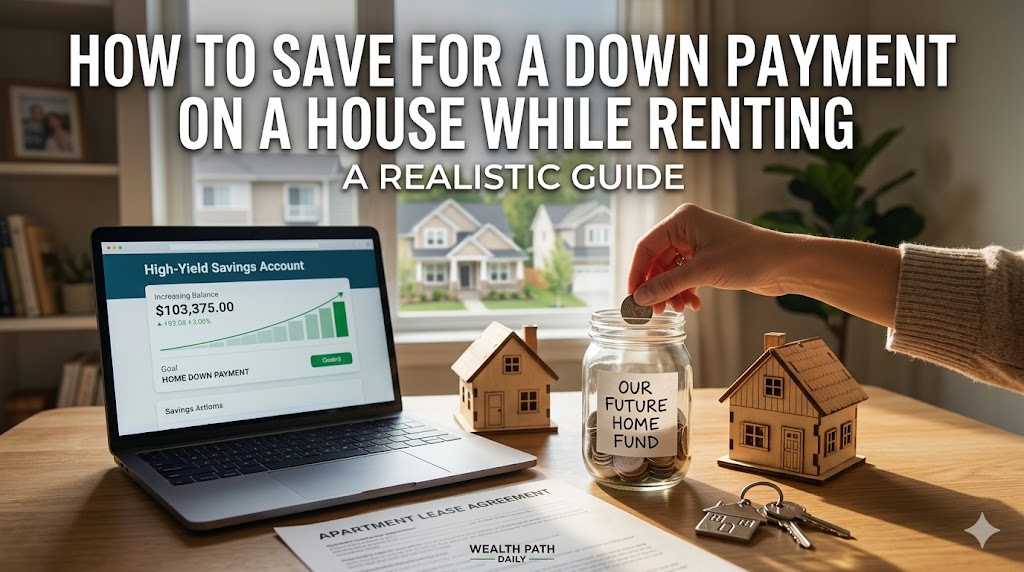
It is one of the most frustrating financial paradoxes of modern adulthood: You want to buy a house so you can stop paying rent, but your rent is so high that you cannot save enough money to buy a house.
If you feel like you are trapped in an endless cycle of funding your landlord’s mortgage while your own dream of homeownership slips further away, take a deep breath. You are not alone, and your goal is not impossible.
Here at Wealth Path Daily, we hear this struggle constantly. Balancing the immediate, heavy burden of monthly rent with the massive long-term goal of a down payment requires more than just skipping your morning coffee. It requires a strategic, focused approach to your entire financial ecosystem.
In this comprehensive guide, we are going to break down exactly how you can successfully save for a down payment while currently renting, without burning yourself out in the process.
Redefining Rent: It Is Not “Throwing Money Away”
Before we dive into the saving strategies, we need to adjust your mindset. One of the most toxic phrases in personal finance is that renting is “throwing money away.”
This simply is not true. Renting buys you a crucial human need: shelter. Furthermore, it buys you flexibility, caps your financial liability (when the water heater breaks, you do not pay for it), and gives you the runway you need to prepare for the massive financial responsibility of homeownership.
Release the guilt associated with renting. Treat your current apartment not as a trap, but as the launchpad for your future wealth.
Step-by-Step Guide to Building Your Down Payment
To escape the rent cycle, you need a highly specific plan. Vaguely hoping to save “enough” will not work. Follow these steps to build your roadmap.
1. Determine Your True Target Number
Many first-time homebuyers are paralyzed by the myth that they absolutely must have a 20% down payment to purchase a home. While putting down 20% is fantastic because it eliminates Private Mortgage Insurance (PMI), it is not a legal requirement.
Look into different loan types to find your actual minimum target:
- FHA Loans: Backed by the government, these often require only 3.5% down.
- Conventional Loans: Many lenders offer first-time buyer programs that require as little as 3% to 5% down.
- VA and USDA Loans: If you qualify, these can require 0% down.
Determine the average price of a starter home in your desired area, calculate 5% to 10% of that number, and add roughly 3% to 5% for closing costs. That is your specific, mathematical target.
2. Practice the “Future Mortgage” Strategy
This is one of the most powerful psychological tricks in real estate planning. Calculate what your future estimated mortgage payment (including taxes and insurance) will be.
If your current rent is $1,500, but your future mortgage will be $2,200, you have a $700 gap. Starting this month, treat your housing cost as if it is already $2,200. Pay your landlord the $1,500, and immediately transfer the remaining $700 into a dedicated savings account.
This strategy accomplishes two things simultaneously: It rapidly accelerates your down payment savings, and it stress-tests your budget to ensure you can actually afford your future house.
3. Audit and Slash Your Current Housing Costs
Because housing is likely your largest expense, it is also the area where you can find the biggest savings. While you are in the aggressive saving phase, consider temporarily lowering your standard of living to supercharge your wealth path.
- Can you get a roommate for the next 12 months?
- Can you move to a smaller, cheaper apartment across town?
- Can you negotiate your lease renewal by offering to sign for 18 months instead of 12?
Slashing your rent by just $300 a month frees up $3,600 a year directly for your house fund.
Actionable Tips to Accelerate Your Savings
To reach your target number faster, you need to optimize how you save and store your cash. Implement these actionable tips right away:
- Park Your Cash in a High-Yield Savings Account (HYSA): Do not let your down payment fund rot in a traditional checking account earning 0.01% interest. Move your house fund to an online HYSA. The compound interest you earn each month is essentially free money added to your down payment.
- Bank Your Windfalls Automatically: Whenever you receive money outside of your normal paycheck—such as an annual tax refund, a work bonus, a cash gift, or the proceeds from selling old furniture—commit to depositing 100% of it directly into your house fund.
- Slay High-Interest Debt First: It is incredibly difficult to save thousands of dollars if you are losing hundreds of dollars a month to credit card interest. Pause your massive down payment goals momentarily to aggressively clear out credit card debt. Once that monthly payment is gone, roll those funds directly into your house savings.
- Investigate Down Payment Assistance Programs (DPAs): Every state, and many individual counties, offer DPA programs for first-time homebuyers. These are often grants (free money) or forgivable loans designed to help middle-to-low-income earners cover their down payment and closing costs. Spend a weekend researching your state’s housing finance agency.
- Automate the Process: Relying on willpower to save money at the end of the month is a losing game. Set up an automatic transfer on the day you get paid. Move the money to your HYSA before you even have a chance to see it in your checking account.
Conclusion: Your Homeownership Goal is Valid and Achievable
Saving for a house while paying rent is undoubtedly a heavy lift, but it is a temporary season of life. It requires you to be hyper-intentional with your budget, to temporarily delay gratification, and to treat your savings with the same urgency as your utility bills.
By calculating your exact target number, stress-testing your future mortgage, optimizing your living situation, and utilizing high-yield accounts, you are laying the bricks for a rock-solid financial foundation. Keep your eyes on the prize, stick to the strategies outlined above, and remember that every dollar saved brings you one step closer to trading your lease agreement for a set of house keys. Your wealth path is leading you home!