
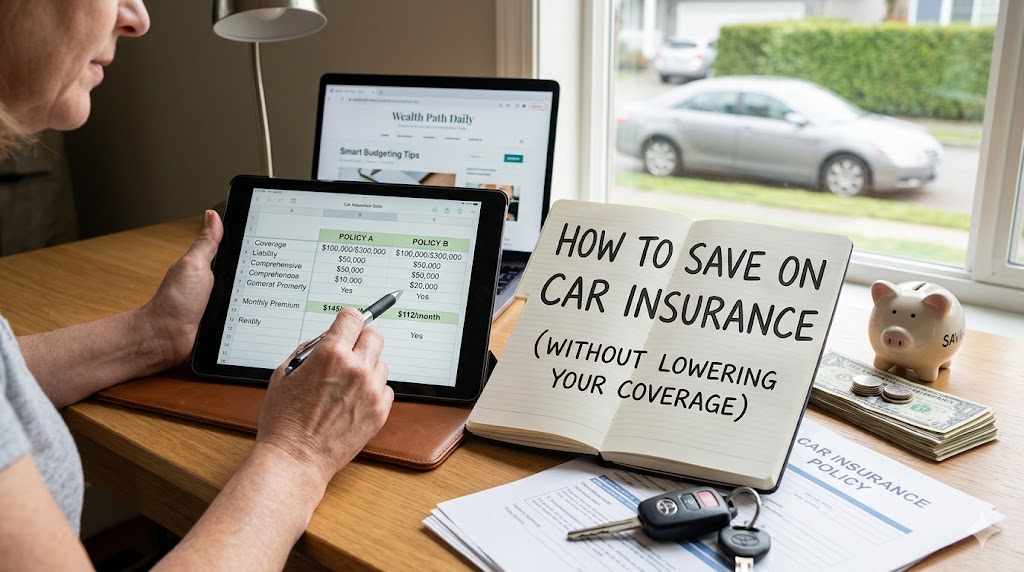
Opening your mail to find a car insurance renewal notice with a higher premium is a universally frustrating experience. In recent years, auto insurance rates have steadily climbed, leaving many drivers wondering how to balance their monthly budget without sacrificing their peace of mind on the road.
When faced with a rising premium, the most tempting reaction is to simply call your provider and slash your coverage limits. But what happens if you get into a major accident? Being underinsured can instantly wipe out your life savings and derail your financial future.
Here at Wealth Path Daily, we believe in protecting your wealth just as fiercely as you build it. The good news is that you do not have to choose between affordability and adequate protection. In this guide, we will walk you through proven, practical strategies to lower your car insurance premiums while keeping your robust coverage completely intact.
Why Slashing Your Coverage is a Dangerous Game
Before we dive into the savings strategies, let us briefly touch on why maintaining high coverage limits is crucial.
Your car insurance policy is fundamentally a shield for your net worth. State minimum liability limits are notoriously low—often barely enough to cover a minor fender bender, let alone a multi-car collision or an accident involving severe medical injuries. If you are at fault in an accident and the damages exceed your coverage limits, the injured party can sue you for the difference. This could result in your wages being garnished or your assets being liquidated.
Cutting your liability limits, dropping uninsured motorist coverage, or removing comprehensive coverage on a newer vehicle to save $20 a month is stepping over dollars to pick up dimes. Fortunately, there are much smarter ways to reduce your bill.
6 Smart Strategies to Lower Your Car Insurance Premiums
You can maintain a fortress of financial protection around your vehicle while still keeping your monthly expenses reasonable. Here is how to make it happen.
1. The Golden Rule: Shop Around Annually
Loyalty rarely pays in the auto insurance industry. In fact, many insurance companies use a practice called “price optimization,” where they gradually raise rates on customers who are statistically unlikely to shop around, even if those customers have perfect driving records.
Make it an annual habit to compare quotes from at least three to four different insurance carriers before your policy renews. You will be surprised at how wildly prices can vary from one company to the next for the exact same level of coverage.
2. Strategically Raise Your Deductible
Your deductible is the amount of money you agree to pay out of pocket before your insurance coverage kicks in after a claim. As a general rule, the higher your deductible, the lower your monthly premium.
If you currently have a $250 or $500 deductible, consider raising it to $1,000. This single move can significantly reduce your premium. However, only do this if you have a fully funded emergency fund. You must ensure you actually have that $1,000 easily accessible in cash should you need to file a claim.
3. Ask About Unadvertised Discounts
Insurance companies offer dozens of discounts, but they will not automatically apply them to your account—you have to ask. Take five minutes to call your agent and run through their discount list. You may qualify for savings through:
- Professional Affiliations: Alumni associations, unions, or specific professions (like teachers or military).
- Vehicle Safety Features: Anti-theft devices, daytime running lights, or advanced braking systems.
- Low Mileage: If you work from home or have a short commute, you are statistically less likely to get into an accident.
- Good Student: If you have a young driver on your policy who maintains a B average or higher.
4. Bundle Your Policies
One of the most effective ways to secure a substantial discount is to purchase multiple types of insurance from the same company. If you currently have your auto insurance with Company A and your homeowners or renters insurance with Company B, you are likely leaving money on the table. Bundling these policies together can often result in a discount of 5% to 25% across the board.
5. Boost Your Credit Score
In most states, insurance companies use a “credit-based insurance score” as a major factor in determining your premium. Statistical data shows that drivers with lower credit scores tend to file more claims.
By actively working to improve your credit score—paying down credit card balances, making all payments on time, and checking your credit report for errors—you will make yourself look like a lower-risk client to insurers, which directly translates to cheaper rates.
6. Consider Usage-Based Insurance (Telematics)
If you are a safe driver, you can let your driving habits speak for themselves. Many major insurers now offer usage-based programs (telematics) that track your driving via a smartphone app or a small plug-in device in your car. These programs monitor behaviors like hard braking, rapid acceleration, late-night driving, and total mileage. If the data proves you are a safe, cautious driver, you can earn discounts of up to 30% on your premium.
Your Quick-Action Insurance Renewal Checklist
Do not let your auto-renew catch you off guard. About 30 days before your current policy expires, run through this simple checklist to guarantee you are getting the best deal:
- [ ] Review your current declarations page to know exactly what coverage limits you currently have.
- [ ] Check your emergency fund to see if you can safely afford to raise your comprehensive and collision deductibles to $1,000.
- [ ] Call your current provider to review your policy and ask explicitly: “Are there any new discounts I qualify for?”
- [ ] Use an online comparison tool or contact an independent insurance broker to get identical coverage quotes from at least three competing companies.
- [ ] Inquire about bundling your auto policy with your home or renters insurance.
Conclusion: Protect Your Wealth, Keep Your Cash
Finding cheap car insurance should never mean sacrificing the quality of your coverage. A robust insurance policy is a non-negotiable part of a solid financial foundation.
By taking a proactive approach—shopping around, optimizing your deductibles, hunting for discounts, and leveraging your good credit and safe driving habits—you can successfully trim the fat from your monthly budget without exposing yourself to unnecessary financial risk. Take an hour this week to review your policy. Your future self (and your wallet) will thank you.